Imbalance and FVG
Price covered a stretch so fast that almost nothing traded there. It likes coming back to close those gaps.
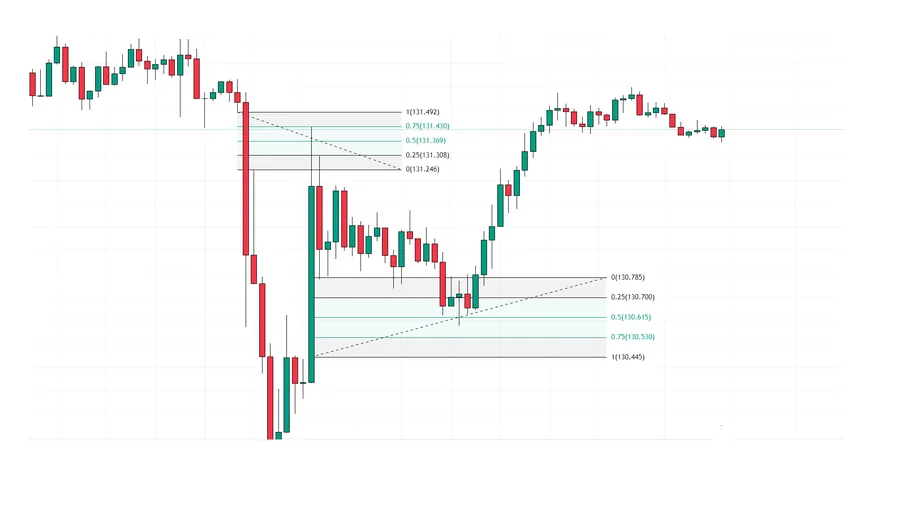
Imbalance and FVG — what it is?
An imbalance is a stretch price covered too quickly, without balanced two-way trading. One side completely overwhelmed the other.
Formally it is defined off three candles: if a gap remains between the wick of the first and the wick of the third, and the middle candle is impulsive, that is an imbalance. Its other name is FVG.
The point is that part of the orders in that stretch never got filled. The market often comes back to pick them up, and only then continues the move.
Imbalance and FVG — how it is built?
The boundaries run from the high of the first candle to the low of the third in the bullish case, and mirror that in the bearish one. A quartile grid goes on top: the edges are alert levels, the 0.25–0.75 range is the entry zone.
Imbalance and FVG — common mistakes
Trading every imbalance. The ones that work formed on a break of structure and next to liquidity.
Waiting for the imbalance to fill completely: price often turns inside it.
Entering at the edge of the zone instead of the entry range.
Going back to an imbalance that has already been worked off.
Related to
Glossary
- imbalance
- a stretch of chart price went through too quickly, without even trading.
- candle
- the element of the chart that shows four prices for a period: open, high, low, close.
- gap
- a break between the close of one candle and the open of the next. On forex it usually appears after the weekend.
- wick
- the thin lines above and below the body that show the high and the low of the period.
- fvg
- the gap between the wicks of the first and third candle in a triple. The formal expression of an imbalance.
- point
- the minimum step of a quote, usually ten times smaller than a pip.