Order block
The last candle against the move before a strong push. Taken as the place a large player entered from.
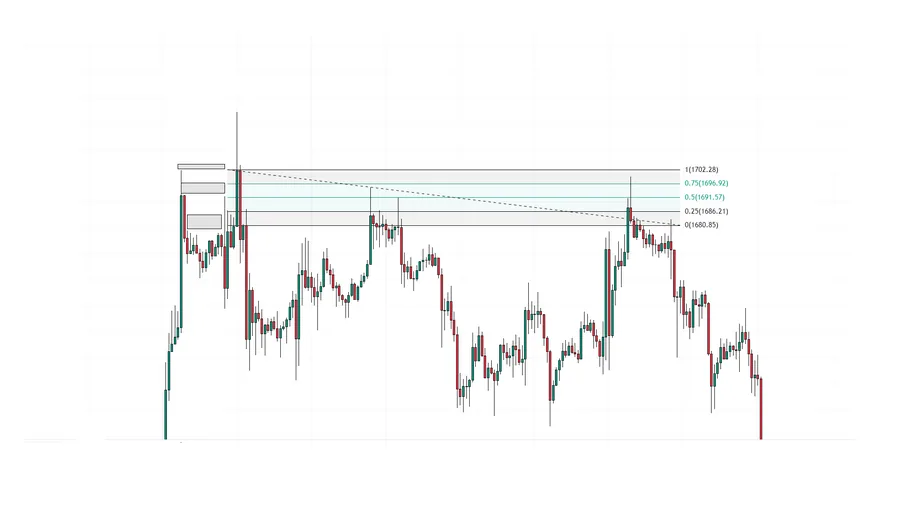
Order block — what it is?
An order block is the last candle of the opposite direction before the impulse that broke structure. Before a strong move up it is the last bearish candle, before a move down the last bullish one.
The point is that a large participant cannot build a position in one order: the market will not give the volume needed at the price needed. They build it where the crowd is selling straight into their hands. The order block is the footprint of that place.
So when price returns to an order block it makes sense to expect a reaction: part of the orders is still unfilled there. Not every order block works — only the one the impulse left with a break of structure and with an imbalance.
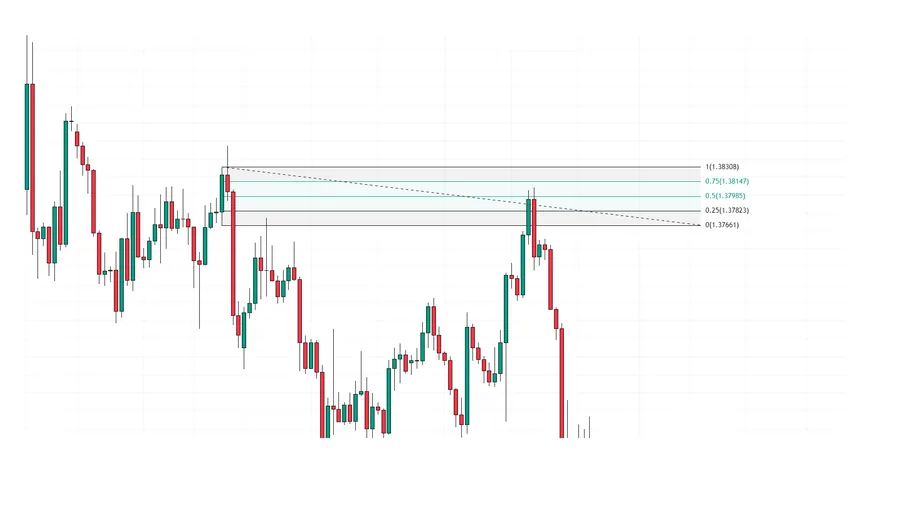
Order block — how it is built?
The boundaries are set by the full range of the candle, wicks included. Exception: if the wick takes up more than 60% of the range, the block is marked by the body. A quartile grid of 0 / 0.25 / 0.5 / 0.75 / 1 goes on those boundaries. Levels 0 and 1 are alert levels — readiness to enter. The 0.25–0.75 range is the entry zone.
Order block — common mistakes
Taking any opposite candle. Without a break of structure it is not an order block, it is a random candle.
Entering at the edge of the zone instead of the 0.25–0.75 range. The edge is a signal to get ready, not to buy.
Ignoring the imbalance. An impulse without one means the move went slowly and left no footprint of a large order.
Going back to a block price has already worked off. After mitigation it no longer works.
Related to
Glossary
- candle
- the element of the chart that shows four prices for a period: open, high, low, close.
- impulse
- a fast directional move with large candles.
- point
- the minimum step of a quote, usually ten times smaller than a pip.
- position
- an open trade.
- volume
- the number of trades or contracts in a period.
- break of structure
- price closing beyond the last structure point **in the direction of the trend**. It confirms continuation.