STB and BTS — zones after a trend change
Zones that appear only after the trend has already turned. Selling becomes buying and the other way round.
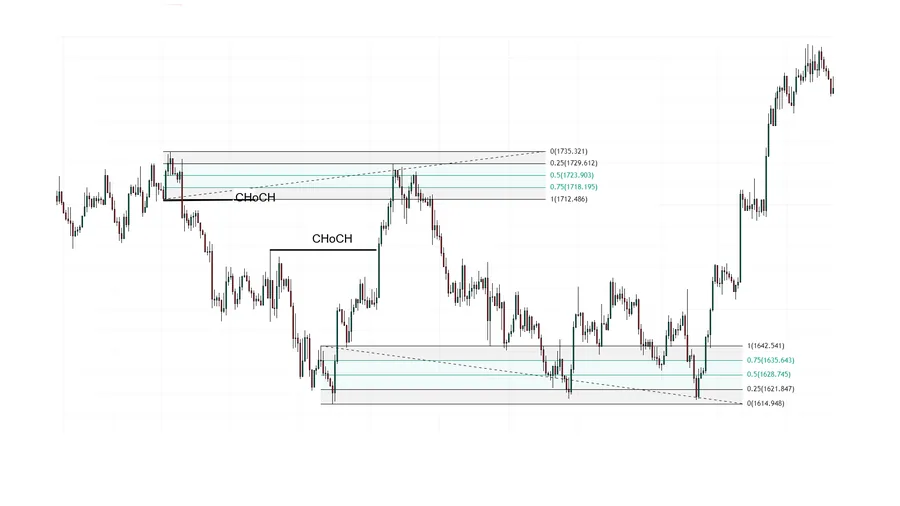
STB and BTS — zones after a trend change — what it is?
STB and BTS are the zones a large participant turned the market from. STB stands for sell-to-buy, BTS for buy-to-sell.
STB forms in a downward move. The last impulse down before a CHoCH up is that zone: buyers' stops and sellers' liquidity were collected in it, after which the market went up. So that is where selling turned into buying.
BTS is the mirror image. The last upward move before a CHoCH down is the place where buying turned into selling. When price returns to such a zone the reaction usually repeats.
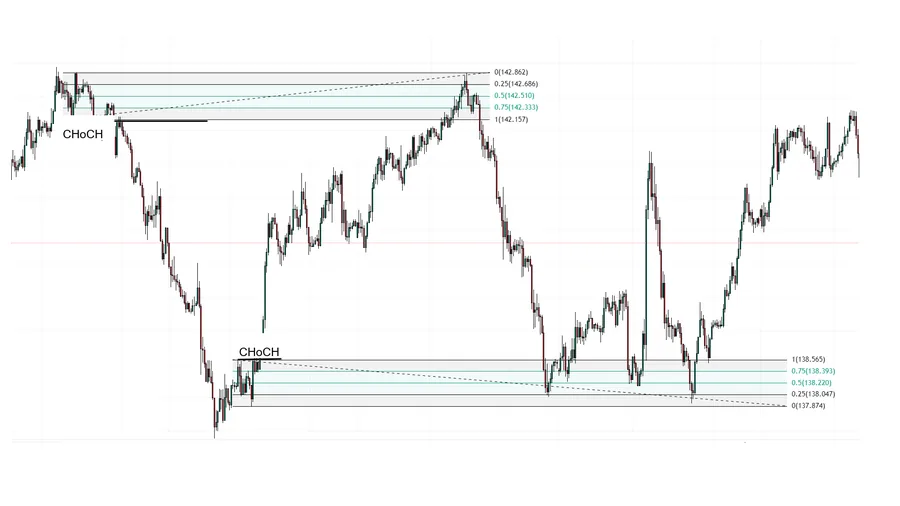
STB and BTS — zones after a trend change — how it is built?
The order: wait for the CHoCH, mark the last move of the opposite direction before it, mark it out by the full range and lay the quartile grid over it. It differs from an order block in scale: there it is a single candle, here it is the whole final move.
STB and BTS — zones after a trend change — common mistakes
Marking the zone before the CHoCH is confirmed.
Taking any convenient move rather than the last one before the break.
Treating the zone as permanent: once worked off it is spent, exactly like an order block.
Confusing it with a breaker: a breaker is a broken order block, STB and BTS are reversal zones.
Related to
Glossary
- impulse
- a fast directional move with large candles.
- change of character
- the first close **against** the trend. It points to a possible reversal.
- liquidity
- a cluster of pending orders and stops in a particular zone. The fuel for large capital to move.
- range
- movement inside a horizontal corridor with no clear direction.
- The quartile grid
- splitting a zone into quarters: 0, 0.25, 0.5, 0.75, 1. The boundaries serve as readiness levels, the middle part as the area to look for an entry.
- Order block
- the last candle in the opposite direction before the impulse that broke structure.