What is Smart Money (SMC) in trading, explained simply
In short: Smart Money Concepts (SMC) is an approach to reading the chart through the logic of large participants: where they build positions, where the crowd's stops sit and how price collects that liquidity. The core ideas are market structure (BOS, CHoCH), liquidity, order blocks and imbalances.
The main idea
A large participant has to execute a big size, and that needs opposing orders. Most of them sit where retail traders place stops: beyond equal highs and lows, beyond obvious levels. That is why price often goes there first and only then moves in the main direction.
Key concepts
BOS — a break of structure with the trend, confirming continuation. CHoCH — the first break against the trend, a sign of a possible reversal. Order block — the last candle before the impulse where the large participant built a position. Imbalance (FVG) — a stretch price moved through too fast.
Where to start
Candles and trend first, then market structure, then liquidity, and only after that order blocks and zones. Without understanding structure, SMC turns into drawing rectangles.
Example of a Smart Money scenario
An uptrend on H1. Buyers' stops have built up under the last low. Price sharply pierces that low — the stops trigger, and a large player buys from those who were knocked out. Then price returns and closes above a local high. A Smart Money trader looks for an entry on the pullback into the zone where that move began (an order block or imbalance), with a stop beyond the swept low.
Myths about Smart Money
"It is the banks' secret system" — no, it is a way to describe how price moves towards liquidity, and it guarantees nothing. "Every order block works" — no, context matters: trend, liquidity taken, the zone's position. "It is the opposite of technical analysis" — in fact it develops Wyckoff's classic ideas about accumulation and distribution.
How to learn without mixing up terms
The most common confusion is BOS versus CHoCH. A BOS is a break of structure with the trend, i.e. continuation. A CHoCH is the first break against the trend, a sign of a possible reversal. A break counts only when a candle closes beyond the level; a wick does not count. In Extremum the terminology is the same across all lessons, articles and the glossary.
Where the Smart Money approach came from
The ideas behind Smart Money are older than the name. As early as the start of the 20th century, Richard Wyckoff described how large players build a position in a range (accumulation) and sell it off (distribution), using the movement of the crowd. The approach took its modern form in recent years, when traders began describing how price goes for liquidity and returns to the zones where strong moves began. Hence the terms: order block, imbalance, liquidity sweep.
Market structure: swings, BOS and CHoCH
A swing is a local high or low after which price turned. In an uptrend each new high is above the previous one. BOS is a break of structure with the trend: price closes above the last high and the trend continues. CHoCH is the first break against the trend: in an uptrend, price closes below the low from which the last high was made. A break only counts on a candle close, not a wick. Structure can be major, internal and micro, and a valid CHoCH breaks a swing of the same level that gave the last BOS.
Liquidity: where the stops are
Liquidity means clusters of orders, most often stop-losses. Buyers put stops below lows, sellers above highs. Especially many stops gather above equal highs (EQH) and below equal lows (EQL): these are obvious levels everyone sees. Price often goes first to take this liquidity — it pierces the level and triggers the stops — and only then reverses. In Smart Money, the cause of a move is the place where liquidity builds up, and the effect is its collection.
Zones of interest: order block and imbalance
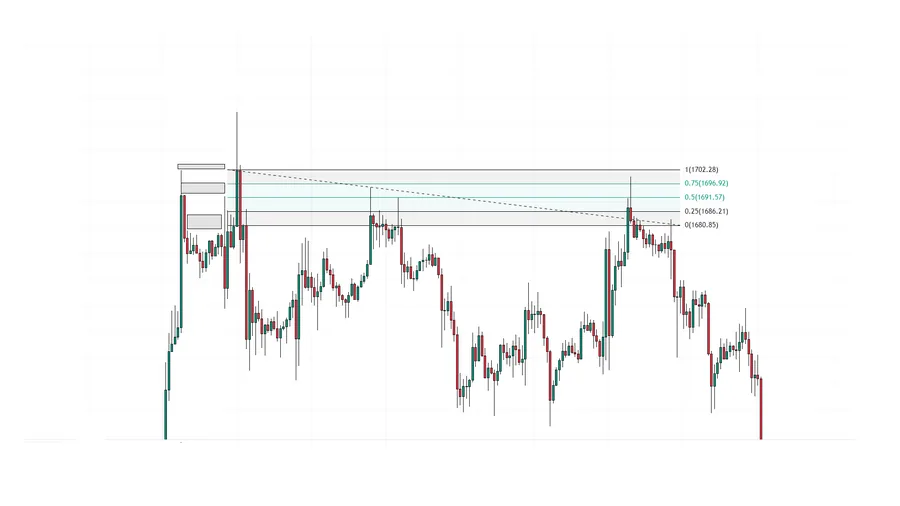
An order block is the last candle against the direction before a strong impulse that broke structure: the zone where the surge began. An imbalance (FVG) is a stretch where price moved so fast that a gap was left between the wicks of neighbouring candles. Price often returns to such zones. Zone boundaries are marked by the full range of the candles, wicks included. A quartile grid of 0 / 0.25 / 0.5 / 0.75 / 1 is laid over the zone: the 0 and 1 boundaries are "alarms", readiness levels, and the entry is sought within the 0.25–0.75 range.
Premium and discount
If you stretch the grid over the whole range of a move — from the low to the high — its upper half is called premium and its lower half discount. The idea is simple: it pays more to buy in discount, below the middle of the range, and to sell in premium. Buying an order block in the upper part of the range is a common mistake: even if the zone looks good, the reward-to-risk ratio there is worse.
A Smart Money trade from start to finish
Step 1: on the higher timeframe, define the direction — for example, an uptrend on H4. Step 2: on H1, wait for a pullback and a sweep of liquidity below a local low. Step 3: see the reaction — price came back up and closed above the internal high. Step 4: find the zone where this surge started, draw the grid and wait for an entry in 0.25–0.75. Step 5: the stop goes beyond the zone and the swept low; the target is the nearest liquidity above. Step 6: risk 1% of the deposit, no more.
Why Smart Money fails for beginners
Most often because of three mistakes. They see an order block in every candle and trade all of them. They ignore the higher timeframe and buy against the H4 trend. They enter without a liquidity sweep, simply "from the zone". Another cause is mixing up terms: if BOS and CHoCH are confused, the whole analysis is turned upside down. Smart Money is not a magic indicator but a language for describing the market, and it only works together with risk management.
Test yourself
First question: uptrend, price closed below the low from which the last high was made — is that BOS or CHoCH? CHoCH. Second: a candle pierced equal lows with a wick and closed above — what happened? Liquidity below EQL was taken; there was no break. Third: in which range of the grid do you look for an entry? 0.25–0.75. In the Extremum app, exercises like these come on real charts, and the correct answer is calculated from data in advance.
Inducement and the poke
An inducement is a small, obvious level inside a move that "invites" traders to enter too early. Price takes this liquidity and only then reaches the real zone of interest. A poke is a move beyond the edge of a range with a quick return inside (in Wyckoff terms, a Spring from below and a UTAD from above): it triggers stops and often comes before a strong move the other way. Both ideas teach the same thing: don't enter at the first obvious level — wait until the market has collected liquidity.
How timeframes connect
In Smart Money you look from the top down. The higher timeframe — H4 or daily — shows the direction and the main zones. The working one — H1 or M15 — shows how price behaves inside those zones: whether it takes liquidity and whether it breaks internal structure. Entries are sought only in the direction of the higher timeframe. A trade against H4 on an M15 signal is one of the most common reasons for losses among those who have just started learning Smart Money.
FAQ
What is Smart Money in simple words?
It is an approach to reading charts that looks at where price goes for liquidity — clusters of stops — and where strong moves began. It helps find entry points with a clear stop.
Does Smart Money work?
As a way to describe the market and find spots with a favourable reward-to-risk ratio — yes. As a guaranteed strategy — no: no approach makes a profit without risk management and statistics.
How is Smart Money different from technical analysis?
It grows out of classical technical analysis: the same trends and levels, but with the focus on liquidity, structure and zones rather than indicators and chart patterns.
How long does it take to learn Smart Money?
The basics — structure, liquidity, zones — can be covered in 2–3 months. Applying them confidently on a chart takes at least half a year of practice with feedback.
Does Smart Money work in crypto?
Yes, especially on liquid coins — BTC and ETH. On illiquid coins and securities, moves are choppy and scenarios play out worse.
What is an order block?
The last candle against the direction before a strong impulse that broke structure. Price often returns to this zone, and that is where an entry is sought, with a stop beyond the zone.
More in the reference
Related questions
🎯 Find your trader type: What kind of trader are you? →
Trading on financial markets carries a risk of losing money. This material is educational and is not investment advice.
All beginner questions · Trading for beginners: where to start