Accumulation and its phases
Price fell for a long time and settled into a sideways corridor. Inside it a large player quietly buys from those who are tired of waiting.
Accumulation and its phases — what it is?
Accumulation is buying up. Price fell for a long time, then stopped and settled into a sideways corridor. Inside that corridor a large participant quietly buys what tired sellers are handing over.
He cannot buy it all at once: his own buying would drive the price up. So he stretches the buying out over time and keeps price in a narrow corridor until he has the volume he needs.
Wyckoff proposed looking at all the large participants as one calculating player and called him the Composite Man. This is not a conspiracy theory: there is no single player, but they act on similar logic. The trick changes the question. Instead of "where will price go", ask "what is in the interest of whoever is accumulating right now". That second question can be answered.
From this comes the rule of cause and effect: the longer and wider the corridor, the further price travels after it leaves. The width of the corridor is a rough estimate of the target. And the rule of effort: if the candles are wide but price barely moves, someone is absorbing that volume.
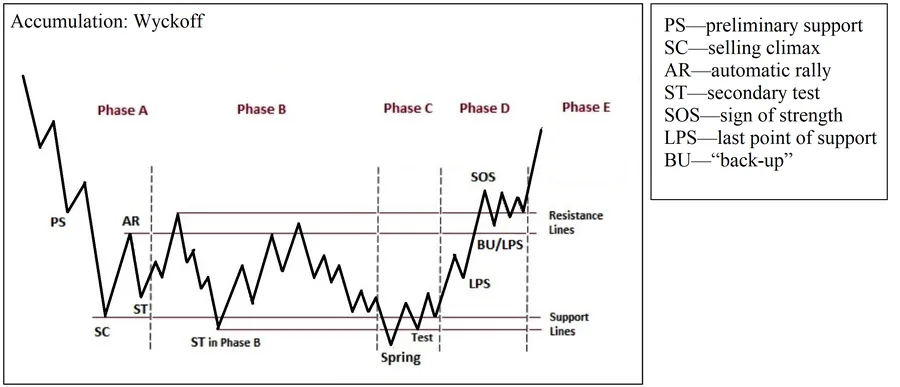
Wyckoff broke the whole process down into five phases. The diagram below is a map: it shows where the market is now and what to expect. Each label is explained under the picture.
- PS — Preliminary support. The fall slowed for the first time: the first buyers showed up. Not the bottom yet, but a sign that sellers are tiring.
- SC — Selling climax. A sharp drop on panic — the last ones capitulate. This exact low becomes the lower boundary of the future corridor.
- AR — Automatic rally. Sellers have run out and price bounces up by itself. The high of that bounce becomes the upper boundary of the corridor.
- ST — Secondary test. Price comes back down to check whether any sellers are left. If the low is not taken out — they are not.
- Phase B — The longest and dullest part. Price walks from boundary to boundary and checks the bottom several times. This is where most people lose money: buying at the top, selling at the bottom.
- Spring — A poke down in phase C. Price dips under the lower boundary and quickly comes back. That is how the stops of everyone who bought inside the corridor are collected, along with the orders of those waiting for a break downward.
- Test — A second approach to the same place, but weaker. It did not take out the low — there are no sellers left down there. A Spring without a test counts as unconfirmed.
- LPS — Last point of support. A higher low that holds. There can be several in a row, each one higher than the last.
- SOS — Sign of strength. Wide candles closing near their highs carry price beyond the upper boundary. The fight is over, the buyer won.
- BU/LPS — Back up to the edge. Price pulls back to the broken boundary and checks whether it has become support. The return should be sluggish — narrow candles, no pushing back through.
- Phase E — The move outside the corridor. The whole point of the exercise.
Accumulation and its phases — how it is built?
Draw the boundaries from phase A: the bottom from the selling climax, the top from the automatic rally. After that follow the events, not the phase letters — an event is verifiable, a letter is not. No trades before phase C. Signs of a Spring: a move beyond the boundary without holding there, a return back inside within one or two candles, then a test above the previous low. In phase D the order matters: first the LPS support, then the SOS impulse, and only then the BU return. Half the Smart Money vocabulary is Wyckoff renamed: the corridor is called a range, the Spring a poke or deviation, the Composite Man smart money, and the LPS an ordinary higher low, HL.
Accumulation and its phases — common mistakes
Calling every sideways corridor accumulation. Buying up only happens after a fall. After a rally the same corridor means the opposite — distribution.
Trading boundary to boundary inside phase B. That is exactly the crowd behaviour the corridor is being held for.
Buying right on the poke without waiting for the return back inside.
Placing the stop right under the low of the poke: price often reaches down there again on the test.
Mixing up the order in phase D. The support comes before the impulse, and the return after the impulse is called BU.
Entering on the SOS itself: that is the worst price and the widest stop. Returns work, impulses do not.
Waiting for a Spring as a mandatory event. Some corridors break upward straight out of phase B, with no poke.
Drawing the boundaries from phase B. The corridor was set back in phase A; after that it is only being tested.
Related to
Glossary
- accumulation
- the phase where a large participant builds a position inside a sideways range.
- long
- buying in expectation of a rise.
- volume
- the number of trades or contracts in a period.
- Wyckoff
- Richard Wyckoff, author of the method for analysing the behaviour of large capital, formulated in the 1930s. Most of the Smart Money vocabulary is a renaming of his concepts.
- composite man
- a notional figure of the large participant whose behaviour explains the market’s moves.
- ask
- the price you can buy at. Always above the bid.
Test yourself
Where is accumulation happening before a rise?
Correct. The app has tasks like this in every lesson — 119 lessons on real charts. Solve in the app →
Not this one. The right answer is the other chart. The app has tasks like this in every lesson — 119 lessons on real charts. Solve in the app →