Quartiles inside the range
The same division into quarters, but for the corridor. It shows where inside it is expensive and where cheap.
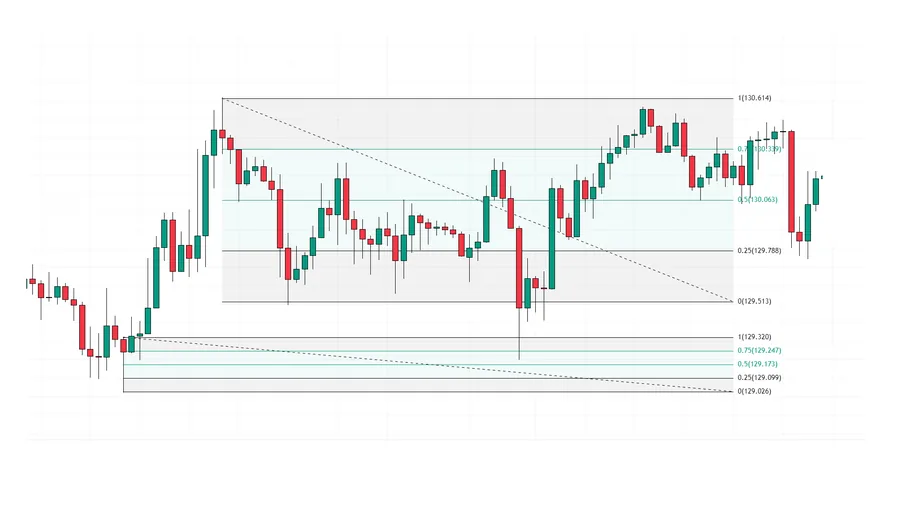
Quartiles inside the range — what it is?
Quartiles in a range are the same 0 / 0.25 / 0.5 / 0.75 / 1 grid, stretched over the whole span rather than a single object.
The 0.5 level becomes the equilibrium of the range: premium and discount are defined relative to it, and it is most often the first target after a sweep beyond a boundary.
The edges of the range act as alert levels: price at a boundary is a signal to get ready for a Spring or a UTAD, not to enter in the direction of the break.
Quartiles inside the range — how it is built?
The grid is built once off the full range of the span and is not recalculated until the range is broken. After a poke the default target is equilibrium, the second target the opposite boundary.
Quartiles inside the range — common mistakes
Rebuilding the grid every time price pokes beyond a boundary with a wick.
Entering at the boundary instead of waiting for the poke and the return.
Treating equilibrium as a reversal level: it is a reference for taking profit, not a signal.
Mixing the range grid with the grid of an individual zone inside it.
Related to
Glossary
- range
- movement inside a horizontal corridor with no clear direction.
- equilibrium
- the middle of the range, the 0.5 level.
- premium
- the upper half of the range. The zone where selling is better.
- discount
- the lower half of the range. The zone where buying is better.
- spring
- a poke below the lower boundary of the range with a quick return inside. In Smart Money vocabulary — a poke down.
- utad
- the final poke upwards before the decline. A poke up.