Pokes
A move beyond the corridor boundary with a return. A Spring at the bottom, a UTAD at the top — different names, same thing.
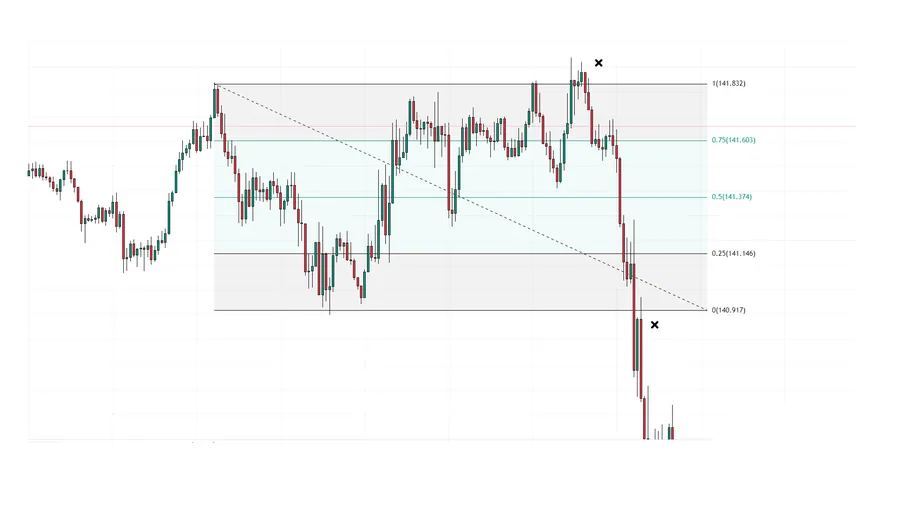
Pokes — what it is?
A poke is a move beyond a range boundary with a quick return inside. The same phenomenon is known as a deviation or a false breakout, and in Wyckoff's terms as a Spring at the bottom and a UTAD at the top.
It has one function: to collect liquidity beyond an obvious boundary. That is where the stops of everyone trading inside the range sit, along with the orders of everyone waiting for a breakout.
The poke is the most informative signal in a range. It shows that the preparation is over, and it marks the side the liquidity has already been taken from.
Pokes — how it is built?
The signs: a move beyond the boundary with no acceptance, a return inside within one or two candles, then confirmation from a change in structure or an imbalance. The entry is looked for against the direction of the poke, the stop beyond its extreme with a buffer, the target equilibrium or the opposite boundary.
Pokes — common mistakes
Entering in the direction of the move beyond the boundary.
Turning around right after the return, without confirmation.
Placing the stop tight behind the extreme of the poke: price often reaches back for it.
Calling a slow move beyond the boundary with acceptance a poke — that is already a breakout.
Related to
Glossary
- Poke
- stepping beyond a range boundary and returning inside. The same thing as Wyckoff’s spring and UTAD.
- range
- movement inside a horizontal corridor with no clear direction.
- False breakout
- price leaving a level and coming straight back. In Smart Money it is treated as a way of collecting liquidity.
- Wyckoff
- Richard Wyckoff, author of the method for analysing the behaviour of large capital, formulated in the 1930s. Most of the Smart Money vocabulary is a renaming of his concepts.
- spring
- a poke below the lower boundary of the range with a quick return inside. In Smart Money vocabulary — a poke down.
- utad
- the final poke upwards before the decline. A poke up.