Swings: HH, HL, LH, LL
A swing is a noticeable turn in price. All structure is built from them: higher and higher means rising, lower and lower means falling.
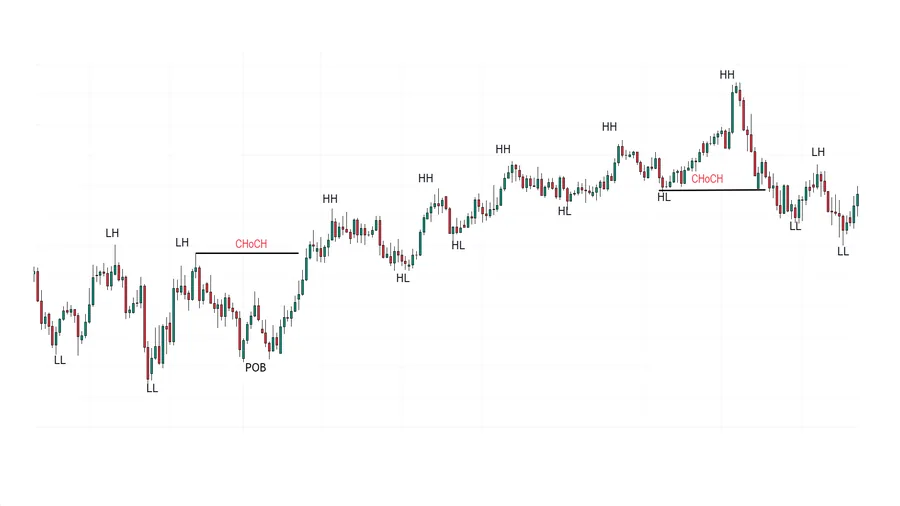
Swings: HH, HL, LH, LL — what it is?
A swing is a local extreme, a turning point of the move. A swing high is surrounded by lower highs, a swing low by higher lows. All structure is built out of swings.
The labels are short: HH is a high above the previous one, HL a low above the previous one, LH a high below the previous one, LL a low below the previous one.
An uptrend is an alternation of HH and HL. A downtrend is LH and LL. A change of character starts when the next pair falls out of the sequence.
Swings: HH, HL, LH, LL — how it is built?
How significant a swing is depends on how many candles surround it. On the working timeframe a point counts as an extreme when at least several candles on each side failed to exceed it. The small oscillations between them are noise of a lower order.
Swings: HH, HL, LH, LL — common mistakes
Marking every local zigzag. Structure should be readable, not cover the chart.
Skipping swings because they don't confirm the opinion you already have.
Mixing swings of different orders into one sequence.
Marking a swing by candle bodies: an extreme is the high and the low, wicks included.
Related to
Glossary
- swing
- a local extreme, the point where a move turns.
- point
- the minimum step of a quote, usually ten times smaller than a pip.
- swing high
- a high surrounded by lower highs.
- lower high
- a high below the previous one.
- swing low
- a low surrounded by higher lows.
- higher low
- a low above the previous one.
Test yourself
Which chart shows an uptrend?
Correct. The app has tasks like this in every lesson — 119 lessons on real charts. Solve in the app →
Not this one. The right answer is the other chart. The app has tasks like this in every lesson — 119 lessons on real charts. Solve in the app →