Inside bar
A candle that fits entirely inside the previous one's range. The market is compressing before the breakout.
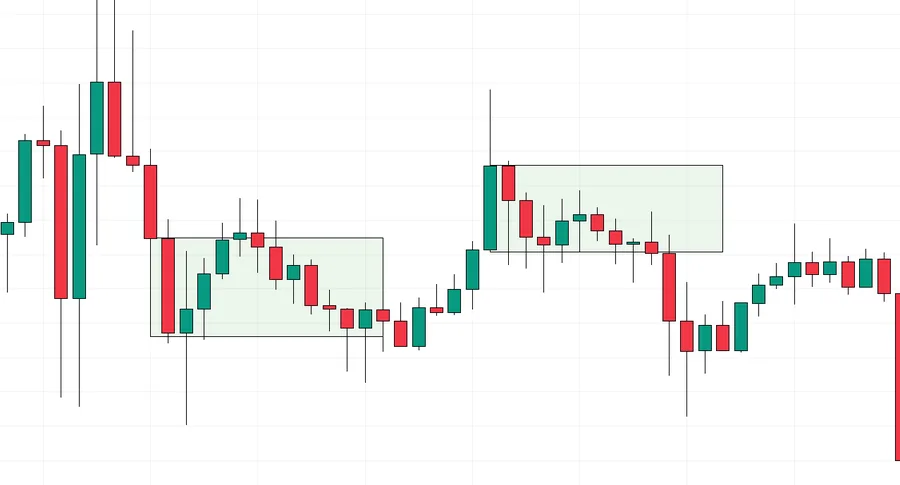
Inside bar — what it is?
An inside bar is a candle whose high is below the previous high and whose low is above the previous low. Its entire range fits inside the previous candle.
This is compression: the market narrowed its range, neither side could make progress. Compression usually ends in expansion.
The practical value lies elsewhere: the edges of the mother candle become obvious to everyone, and stops pile up beyond both of them. Often one side is broken first and the move goes the other way.
Inside bar — how it is built?
The full range is compared: high and low with the wicks included. Several inside bars in a row strengthen the effect — compression builds up, and the exit from it comes out sharp.
Inside bar — common mistakes
Entering in the direction of the first break of an edge. That's exactly where liquidity gets taken.
Confusing it with a harami: there only the bodies are compared.
Trading inside bars on autopilot without looking at structure.
Placing your stop right beyond the edge of the mother candle — that's the most obvious spot of all.
Related to
Glossary
- candle
- the element of the chart that shows four prices for a period: open, high, low, close.
- high
- the highest price of the period.
- low
- the lowest price of the period.
- range
- movement inside a horizontal corridor with no clear direction.
- liquidity
- a cluster of pending orders and stops in a particular zone. The fuel for large capital to move.
- Harami
- a candle that fits entirely inside the body of the previous one.